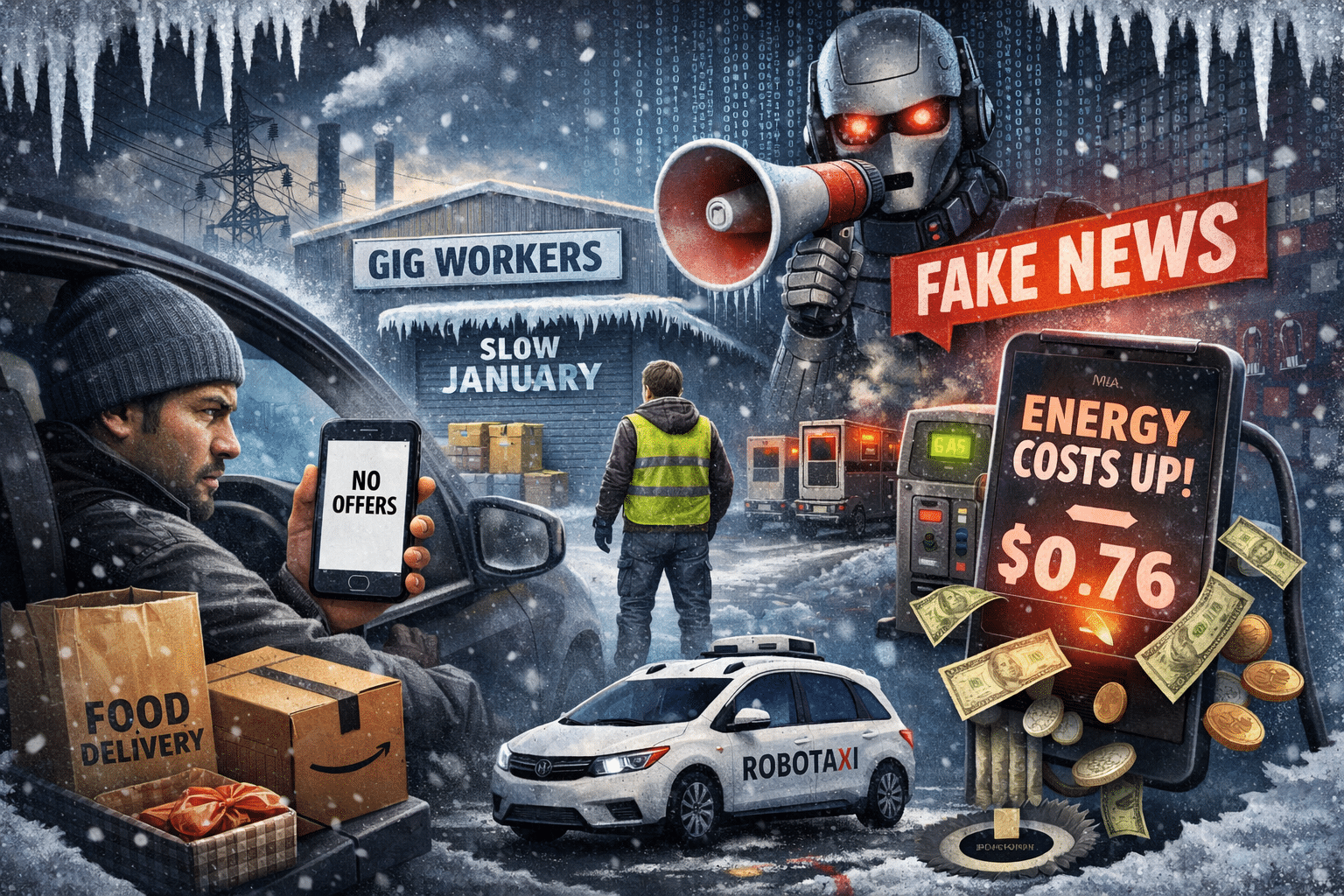
January in the gig economy hits like a cold front. Demand fades, shoppers hoard routes, and drivers stare at blank screens wondering if the warehouse moved or the app died. We talk about dry January and why it means dry wallets, then get tactical. If you rely on gig income, the only safe move is a multi‑app portfolio: rideshare, food delivery, parcels, and shopping, plus reserve systems where they work. Rates dip and offers vanish, so flexibility becomes strategy. Accepting less for Amazon routes or switching to Instacart for a weekend grocery surge can keep cash flowing. The real lesson is to plan for seasonal troughs, stack savings when December pops, and refuse to depend on one platform.
Misinformation became its own gig. A viral “DoorDash whistleblower” turned out to be AI, and it still lured press, executives, and half the internet. That’s the new landscape: text that looks real and spreads faster than corrections. We discuss how to spot digital tells, why slush‑fund claims smelled off, and why companies must verify before reacting. Then we zoom out to AI’s infrastructure: data centers eating power and pushing local utility rates up. Towns take huge buyouts, neighbors get sticker shock, and Microsoft promises to absorb increases around new facilities. It’s not abstract for drivers; higher electricity hits EV charging, home bills, and warehouse costs that ripple into payouts.
Policy keeps sprinting to catch up. California’s new rule mandating full refunds for wrong or missing orders sounds great until you picture repeat abusers. We like the promise of live human support and fast refunds, but there must be guardrails: limits on serial claims, proof thresholds, and shielding restaurants from fraudulent chargebacks. When customers lie, they don’t hit a faceless app; they punch the cook, the courier, and the margins. The Brooklyn‑style broccoli saga drives home another point: training matters. If a Spark shopper confuses crowns with florets and weighs a nugget at five cents, that’s not just a joke; it’s a systems issue where quality checks and clearer UI could prevent waste and refunds.
Trust and data collide in less obvious ways. Amazon Flex couriers are nudged to install a third‑party safe‑driving app to earn gift cards. We question the bargain: small perks traded for driving telemetry that can mark you as a hard braker in someone’s algorithm. Even if Amazon says it won’t receive the data, aggregators monetize somehow. A driver’s risk profile can outlive a $25 code, and gig workers have learned the hard way that “not affiliated” can evolve. Meanwhile, Uber is building kiosks at airports for travelers without data plans. It’s smart access design: order at a screen, pay, and get a printed receipt with car details. It also reveals an untapped market that still hasn’t tried rideshare, and that means more trips for drivers when systems don’t fail.
Autonomy keeps making headlines, sometimes for the wrong reasons. A Waymo halted on train tracks captured the uncanny valley of safety: machines that promise superhuman perception still make human‑seeming mistakes. Contrast that with Zooks in Las Vegas: no steering wheel, bi‑directional motion, roomy cabins, and permissive rules for food and drink. Seven years of mapping before public launch shows a different posture—slow, careful, and local. On the delivery side, China’s autonomous vans bulldozing through construction and snow shows what happens when speed outruns safety. Packages survive less than sidewalks. If this becomes the norm, regulators and insurers will rewrite the rules before drivers see benefits.
Finally, we unpack New York City’s allegation that Uber Eats and DoorDash redesigned tipping flows to suppress pre‑checkout tips, slicing average tips from $2.17 to $0.76. If accurate, that’s a massive pay cut masked as “UI changes.” Tips shouldn’t be the foundation of pay, but they are. Moving tipping to post‑delivery shifts psychology: fewer taps, more friction, lower earnings. Workers need transparency on payout timing, tip presentation, and minimums that don’t get clawed back by design. There’s a brighter note: Walmart and Wing are scaling drone delivery to reach tens of millions. For suburban logistics, drones could take the low‑weight, high‑frequency runs and free drivers for higher‑value routes. Noise and airspace will be challenges, but the mix of drones, vans, and human couriers might finally balance speed with earnings. Until then, resilience means diversifying, saving through the peaks, and pushing apps—and lawmakers—for fair design.